↓
 

Madison Land Surveying

...a USA Surveying & Engineering marketing website.


  • Home
  • ALTA Survey
  • Boundary Surveying
  • Drone LiDAR Mapping
  • Elevation Certificate
  • Land Surveying
  • Lot Survey – Closing Survey
  • Topographic Survey
  • Blog
  • Contact Us
    • About Us
    • Athens Land Surveyor
    • Decatur Land Surveyor
Home 1 2 3 … 6 7 >>

Post navigation

← Older posts

Welcome to Madison Land Surveying

Madison Land Surveying Posted on December 18, 2017 by Madison SurveyorMay 2, 2018

Welcome to Madison Land Surveying

This site is intended to provide you with information on Land Surveying in the Madison, AL and Madison County area of Alabama. If you’re looking for a Madison Land Surveyor, you’ve come to the right place. If you’d rather talk to someone about your land surveying needs, please call our local number at (256) 585-6346 today. For more information, please continue to read.

madison land surveyingLand Surveyors are professionals who make precise measurements to determine the size and boundaries of a piece of real estate.  While this is a simplistic definition, boundary surveying is one of the most common types of surveying related to home and land owners. If you fall into the following categories, please click on the appropriate link for more information on that subject:

Madison Land Surveying services:

    1. I need to know where my property corners or property lines are. (Boundary Survey)
    2. I have a loan closing or re-finance coming up on my home in a subdivision. (Lot Survey)
    3. I need a map of my property with contour lines to show elevation differences for my architect or engineer. (Topo Survey)
    4. I’ve just been told I’m in a flood zone or I’ve been told I need an elevation certificate in order to obtain flood insurance or prove I don’t need it. (Flood Survey)
    5. I’m purchasing a lot/house in a recorded subdivision. (Lot Survey – See Boundary Survey)
    6. I’m purchasing a larger tract of land, acreage, that hasn’t been subdivided in the past. (Boundary Survey)

Contact Madison Land Surveying services TODAY at (256) 585-6346.

Posted in alta survey, boundary surveying, elevation certificate, flood survey, land surveying, land surveyor, lot survey, property survey, topographic survey | Tagged land surveyor, Madison AL Land Surveyor, Madison Land Surveying

Do You Need an Elevation Certificate? Here’s What Homeowners Should Know Before Buying

Madison Land Surveying Posted on June 3, 2026 by Madison Land SurveyingJune 1, 2026
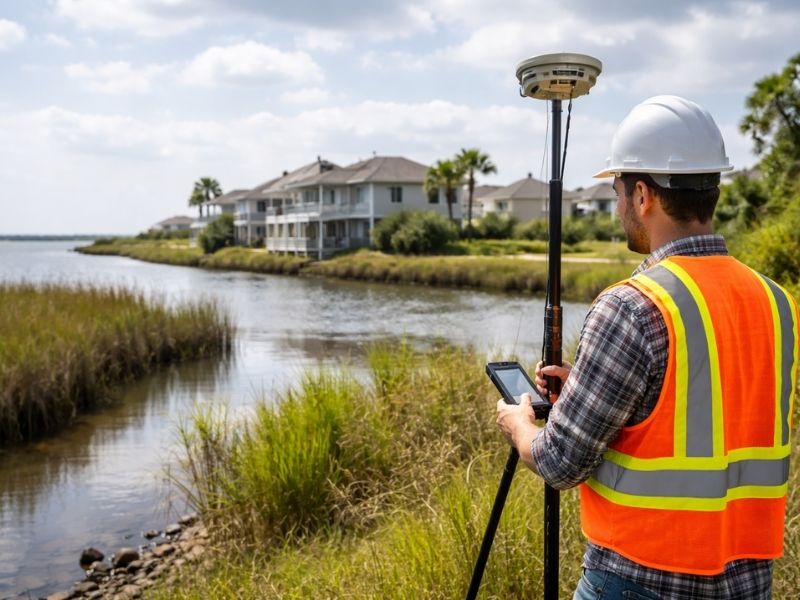
Land surveyor using GPS equipment near a waterfront home to collect elevation data for an elevation certificate

Most buyers ask about school districts, square footage, and roof age. Few ask about the elevation certificate. That’s a mistake that can cost thousands of dollars a year in flood insurance premiums, or worse, cause a lender to block the closing entirely. If the property you’re buying sits anywhere near a flood zone, this document matters more than most people realize.

What Is an Elevation Certificate?

An elevation certificate (EC) is an official FEMA document prepared by a licensed land surveyor. It records the elevation of a building’s lowest floor relative to the Base Flood Elevation (BFE) for that property. The BFE is the flood height expected during a 1-percent-annual-chance flood event, commonly called a 100-year flood.

The certificate captures specific details: the property’s flood zone designation, the height of the lowest floor, foundation type, and whether a basement or enclosure is present. Insurance companies use this data when calculating flood insurance premiums under the National Flood Insurance Program (NFIP).

Who Actually Needs One

Not every homeowner needs an elevation certificate. But several situations make one either required or worth getting.

You’ll likely need one if:

  • The property is in a Special Flood Hazard Area (SFHA), typically Zone A or Zone V on FEMA’s Flood Insurance Rate Map
  • A federally backed lender requires flood insurance as a condition of the mortgage
  • The home was built new or substantially improved within a mapped flood zone, since most communities require an EC before issuing a certificate of occupancy in these cases
  • You want to apply for a Letter of Map Amendment (LOMA) to challenge the property’s flood zone designation

You may want one even if it’s not required. Under FEMA’s current Risk Rating 2.0 pricing system, an EC is no longer mandatory just to purchase an NFIP policy. But submitting one to your insurance agent can document that your home sits above the BFE, which may reduce your premium.

How an Elevation Certificate Can Lower Your Flood Insurance Bill

This is where the math gets interesting.

FEMA warns that just one inch of floodwater can cause $25,000 in damage to a home. The average NFIP claim payment between 2020 and 2024 was more than $82,000. Yet many homeowners overpay on flood insurance simply because their insurer doesn’t have current elevation data on file.

If a home’s lowest floor sits above the BFE, the insurer revises the risk calculation downward. A property showing 1.25 feet of freeboard above BFE can qualify for roughly a 9.85% discount on the premium, according to FEMA data. For homeowners paying $1,200 a year, that kind of reduction adds up fast.

The national average cost for an elevation certificate runs about $600, with a typical range of $400 to $900 for residential properties. A certificate that saves $500 or more per year pays for itself within the first 12 months.

What the Certificate Actually Measures

A surveyor fills out the EC form using field measurements and FEMA flood map data. The key pieces of information include:

  • The flood zone and BFE for the property
  • The elevation of the lowest floor, including any attached garage, crawlspace, or enclosure
  • The type of foundation (slab, crawlspace, basement, or elevated)
  • Whether flood openings are present and how many
  • The elevation of any machinery or equipment serving the building

Each of these factors feeds directly into how an insurer or local floodplain manager evaluates the property’s risk.

Basements are handled separately. They are measured below the first floor and treated as an independent risk indicator. If the property has one, it gets noted on the certificate.

When the Certificate Is Required for New Construction

Developers and builders working in or near flood zones face stricter requirements. Any new construction or substantial improvement within a mapped SFHA almost always requires a pre-construction elevation certificate before permits are issued. A finished construction elevation certificate is then required again before the certificate of occupancy is granted.

A substantial improvement is generally defined as any repair or renovation where the cost equals or exceeds 50% of the structure’s pre-improvement market value. That threshold catches more projects than most developers expect, so checking flood zone status early in the due diligence process saves time.

How Long an Elevation Certificate Is Valid

There is no expiration date on an elevation certificate. Once completed by a licensed surveyor, it remains valid unless the property undergoes substantial changes or FEMA updates the flood maps for the area.

If FEMA issues a new Flood Insurance Rate Map (FIRM) for your community, the old certificate may no longer reflect current conditions. Getting an updated Elevation Certificate after a map revision can protect against premium increases that otherwise kick in automatically when flood zone designations change.

One more thing to check: communities can earn discounts of up to 45% on NFIP premiums through FEMA’s Community Rating System (CRS) program. These community-wide discounts apply to all policyholders in participating communities, independent of any individual Elevation Certificate. Knowing whether the municipality participates in CRS is worth a quick call to the local floodplain manager before buying.

How to Get One

Three options exist for obtaining an elevation certificate:

First, check if one already exists. Many properties built after the local FIRM was published have an Elevation Certificate on file with the local floodplain administrator. It’s free to request and can save the cost of ordering a new one.

Second, contact your local floodplain manager. For properties in flood zones, this office often maintains records and can direct you to existing certificates.

Third, hire a licensed land surveyor. If no existing Elevation Certificate is on file, a surveyor will visit the property, take the required measurements, and complete the FEMA form. Turnaround time typically runs three to seven business days for a standard residential property.

Frequently Asked Questions

What is an elevation certificate and what is it used for? 

An elevation certificate is a FEMA document completed by a licensed land surveyor. It records a building’s elevation relative to the Base Flood Elevation and is used to determine flood insurance premiums, verify compliance with local floodplain regulations, and support applications for flood map amendments.

Is an elevation certificate required to buy flood insurance? 

Under FEMA’s current NFIP pricing system (Risk Rating 2.0), an elevation certificate is no longer required to purchase a flood insurance policy. However, submitting one may lower your premium if the data shows the home sits above the Base Flood Elevation.

How much does an elevation certificate cost? 

The national average is around $600, with most residential properties falling between $400 and $900. Commercial properties, remote parcels, and difficult-access sites typically cost more.

How long is an elevation certificate good for? 

There is no expiration date. The certificate remains valid unless the property is substantially improved or FEMA remaps the flood zone. After a map revision, getting an updated certificate helps ensure your insurance rate reflects current conditions.

Who prepares an elevation certificate? 

Only a licensed land surveyor, engineer, or architect authorized by law to certify elevation information can complete an official elevation certificate. It cannot be self-prepared by the property owner.

Posted in land surveying | Tagged elevation certificate

What Is a Metes and Bounds Survey? A Guide for Property Owners

Madison Land Surveying Posted on June 2, 2026 by Madison Land SurveyingJune 1, 2026
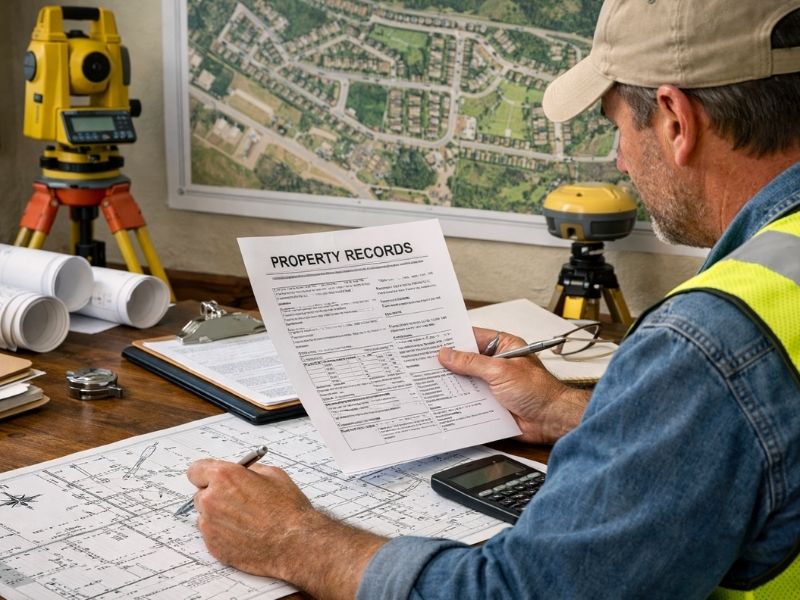
Land surveyor reviewing property records and survey plats while researching a metes and bounds survey

You pull up an old deed on a rural parcel and the legal description reads something like: “Beginning at an iron pin on the north side of the county road, thence north 42 degrees east, 210 feet to a stone monument…” If that sounds confusing, you’re not alone. A metes and bounds survey is one of the oldest ways to describe property in the United States, and it still shows up on deeds across the South today. Knowing how it works can save you from a costly dispute before you ever break ground.

What “Metes and Bounds” Actually Means

The term comes from two Old English words. “Metes” refers to measured straight-line distances between points. “Bounds” refers to physical features that mark the edges of a property, like a road, a creek, a fence line, or a stone wall.

Together, a metes and bounds description traces the full perimeter of a parcel. It starts at a fixed point called the Point of Beginning (POB), moves in a specific direction for a specific distance, then turns again, and again, until it closes back at the starting point.

A basic example might read:

“Beginning at the iron pin set at the intersection of Elm Road and Oak Lane, thence N 30 degrees E, 150 feet to an iron pin; thence S 60 degrees E, 100 feet to a concrete monument…”

Each “thence” is a new leg of the boundary. When the description returns to the POB, the boundary is closed.

Where Metes and Bounds Surveys Are Still Used

The U.S. largely moved away from metes and bounds after the Land Ordinance of 1785, which introduced the Public Land Survey System (PLSS) for central and western states. But the original eastern states continued using metes and bounds for land that was already divided before the PLSS took over.

That means older rural parcels across the South, especially those that were never formally platted into a subdivision, still carry metes and bounds descriptions in their deeds. If you’re buying or developing raw acreage, there’s a real chance the deed uses this system.

Why Metes and Bounds Descriptions Cause Problems

Old descriptions were only as good as the monuments used to write them. A surveyor in 1940 might have called out “the large oak tree at the creek bend” as a boundary point. That tree could be gone now. The creek may have shifted.

This is where disputes start.

When a physical monument is missing, two adjacent property owners can end up with conflicting ideas about where the line actually falls. If the deed language is vague, or if distances in the description don’t close properly, a title company may flag the parcel. That can slow or kill a sale.

State property law in many Southern states allows adverse possession claims on boundary disputes after a set number of years of continuous use. That means a neighbor who has been maintaining land up to a disputed line long enough could have a legal claim to it, even if your deed says otherwise.

How a Metes and Bounds Survey Gets Done Today

A licensed land surveyor starts by researching the deed and any recorded documents tied to the property. They look at adjoining deeds, plats, and county records to piece together the chain of title.

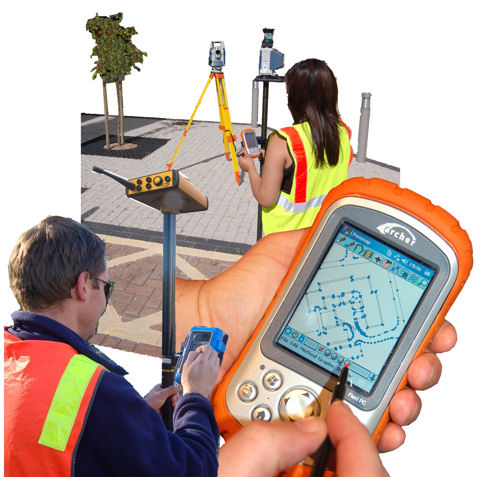
Then they go to the field. They look for existing monuments, iron pins, concrete markers, or any physical evidence of prior surveys. When monuments are missing, they use GPS, total stations, and other precision equipment to recalculate where the corners should be based on the written description and surrounding evidence.

Once the survey is complete, the surveyor prepares a plat showing the boundary, any discrepancies found, and the legal description that matches the actual ground conditions. That plat becomes the official record.

This process is more involved than surveying a standard subdivision lot. Rural parcels with old deed language can take more research time, which is part of why metes and bounds surveys cost more than a basic lot survey.

When You Need a Metes and Bounds Survey

You’ll likely need one in these situations:

  • You’re buying rural acreage that has never been subdivided
  • The deed description references old monuments that may no longer exist
  • You want to build on or develop a parcel with an irregular shape
  • A neighbor is disputing your boundary line
  • You’re subdividing a larger tract into smaller parcels
  • A title company flags the legal description during closing

Developers working on large rural tracts run into metes and bounds descriptions regularly. Getting a current survey done before closing is the only way to know if the description on paper matches what’s actually on the ground.

Metes and Bounds vs. Lot and Block: What’s the Difference?

Lot and block descriptions are used for platted subdivisions. They simply reference a lot number, block number, and the recorded subdivision plat. They’re short, clean, and easy to pull up.

Metes and bounds descriptions are used for parcels that don’t fit that system, whether because the land predates formal platting, or because the shape is too irregular for a standard grid. Rural acreage, oddly shaped commercial parcels, and older residential lots outside of recorded subdivisions often use metes and bounds.

If your deed has directions, distances, and compass bearings in it, you’re looking at a metes and bounds description.

Frequently Asked Questions

What is a metes and bounds survey? 

A metes and bounds survey defines property boundaries using a series of directions and distances, starting and ending at a fixed point called the Point of Beginning. Each segment uses a compass bearing and a measured distance to trace the full perimeter of the parcel.

Are metes and bounds descriptions still common today? 

Yes. Rural and older parcels across the eastern United States frequently carry metes and bounds descriptions in their deeds, especially land that was recorded before formal subdivision platting became common in the area.

What happens if a monument in a metes and bounds description no longer exists? 

A licensed surveyor researches deed records and adjacent properties to reconstruct where the missing monument would have been. They use current survey equipment to re-establish the corner based on the best available evidence.

Can a bad metes and bounds description delay a closing? 

Yes. If the description doesn’t close properly, references missing monuments, or conflicts with adjacent deeds, a title company may require a new survey before it will issue title insurance on the property.

How long does a metes and bounds survey take? 

It depends on the size of the parcel and the condition of the existing records. Straightforward parcels with clear documentation can be completed in a few days. Older tracts with missing monuments or conflicting deeds take longer because of the additional research involved.

Posted in land surveying | Tagged Land Surveying, land surveying madison, metes and bounds survey

How LiDAR Mapping Is Transforming Land Development

Madison Land Surveying Posted on June 1, 2026 by Madison Land SurveyingJune 1, 2026
Land surveyor reviewing site plans during a LiDAR mapping and land development survey at a construction site

If you’ve ever watched a development project stall because the site data was wrong, you already know how expensive bad information gets. LiDAR mapping is changing that. It gives developers faster, more accurate terrain data before a single dollar goes into grading or design, and it’s quickly becoming the standard for serious land development work.

What Is LiDAR Mapping?

LiDAR stands for Light Detection and Ranging. A sensor fires millions of laser pulses per second at the ground and measures how long each pulse takes to bounce back. The result is a dense “point cloud,” a three-dimensional picture of the terrain with vertical accuracy down to 10 centimeters, according to the U.S. Geological Survey.

That matters because ground conditions are rarely what they look like on paper.

When a drone carries a LiDAR sensor over a site, it captures everything: bare soil, tree canopy, drainage channels, subtle elevation changes that wouldn’t show up on older maps. And it does it fast. A 200-acre site that would take a traditional ground crew 3 to 5 days to survey can be flown in 2 to 3 hours.

Why Developers Are Using LiDAR Mapping on More Projects

Speed is the first reason. But accuracy is the bigger one.

Traditional ground surveys are reliable, but they sample the terrain at specific points. LiDAR captures 200 to 400 data points per square meter across the entire site. That density reveals problems early, before they show up as change orders.

Here’s what developers are using it for:

Grading and earthwork planning. Accurate cut-and-fill calculations depend on accurate elevation data. LiDAR-generated digital elevation models give engineers the numbers they need to optimize earthwork before the job starts.

Drainage and stormwater design. LiDAR picks up subtle grade changes that ground surveys miss. That means stormwater engineers get a clearer picture of how water moves across the site, and how to manage it.

Subdivision planning on large tracts. When you’re laying out roads, lots, and utility corridors across a large parcel, having a complete 3D terrain model reduces the guesswork at every phase.

Sites with heavy vegetation. LiDAR pulses penetrate tree canopy to record the actual ground surface underneath. That’s critical on wooded parcels where photogrammetry alone won’t show you what’s there.

LiDAR Mapping vs. Traditional Surveying: What’s the Difference?

Both methods produce accurate data. The difference is scope and speed.

Traditional surveying is still the right tool for legal boundary work. Property lines, corners, and plat maps require a licensed surveyor using methods that hold up in court. LiDAR doesn’t replace that.

What LiDAR replaces is the time-consuming task of capturing detailed topographic data across large areas. According to the USGS, LiDAR surveys can cut mapping timelines by up to 60 percent compared to traditional ground-based methods. Some sources put field data collection savings as high as 80 to 90 percent on large sites.

For developers, the practical result is this: you get better terrain data, faster, at a cost that makes sense on projects of scale.

When LiDAR Makes the Most Sense

LiDAR isn’t the right call on every project. A small residential lot doesn’t need it. But it earns its cost quickly when:

  • The site is 10 acres or larger
  • The terrain is uneven or heavily wooded
  • The project involves road design, stormwater engineering, or utility routing
  • You need a 3D model for engineering or architecture coordination
  • The site has drainage concerns that need to be solved before design begins

How the Data Gets Used After the Survey

The raw point cloud is only the starting point. Once it’s processed, surveyors and engineers can generate:

Digital elevation models (DEMs). A gridded surface that shows ground elevation across the entire site. Used for grading design, flood analysis, and drainage planning.

Contour maps. Derived directly from the DEM, these give architects and site engineers the topographic context they need to design.

3D site models. Useful for project visualization, stakeholder presentations, and coordination with design teams.

Bare-earth models. Vegetation and structures are stripped out, leaving only the ground surface. Useful for sites where tree cover hides the real grade.

All of this data can be imported into CAD and GIS platforms, which means it plugs directly into the tools your engineers already use.

What the LiDAR Market Looks Like Right Now

The numbers show how fast adoption is moving. The LiDAR market was valued at about $2.06 billion in 2024 and is projected to reach $15.37 billion by 2033, growing at roughly 25 percent per year. That growth is being driven by construction, infrastructure development, and land planning, not just tech or autonomous vehicles.

More developers are requesting LiDAR data as part of the pre-design phase because the cost of getting it is dropping while the cost of not having it stays the same.

Frequently Asked Questions

Can LiDAR mapping replace a traditional boundary survey? 

No. LiDAR is a topographic data collection tool. It captures terrain and elevation data, not legal property boundaries. You still need a licensed land surveyor for boundary work, plat preparation, and anything that affects legal ownership.

How accurate is drone LiDAR for land development work? 

Drone LiDAR typically achieves vertical accuracy of around 10 centimeters, which meets the requirements for grading design, drainage engineering, and site planning on most development projects.

How long does a LiDAR survey take? 

A 200-acre site can be flown in roughly 2 to 3 hours. Processing the point cloud data into usable deliverables takes additional time depending on the complexity of the site and the outputs needed.

Is LiDAR worth the cost on smaller projects? 

For sites under 10 acres with simple terrain, traditional topographic methods are usually more cost-effective. LiDAR delivers the best return on larger or more complex parcels where the data density and speed justify the cost.

What file formats does LiDAR data come in? 

Processed LiDAR data is commonly delivered as LAS or LAZ point cloud files, along with GeoTIFF elevation rasters and DXF or DWG files for use in CAD. Most civil engineering and GIS software can import these formats directly.

Posted in land surveying | Tagged Land Surveying, land surveying benefits, lidar mapping

Post navigation

← Older posts
Get Quote Button

Recent Posts

  • Do You Need an Elevation Certificate? Here’s What Homeowners Should Know Before Buying
  • What Is a Metes and Bounds Survey? A Guide for Property Owners
  • How LiDAR Mapping Is Transforming Land Development
  • How an ALTA Survey Helps Prevent Commercial Property Disputes 
  • How to Find Property Lines  

Categories

  • alta survey
  • boundary surveying
  • construction
  • construction survey
  • elevation certificate
  • flood damage
  • flood survey
  • land surveying
  • land surveyor
  • LOMA
  • lot survey
  • property survey
  • topographic survey
© USA Surveying & Engineering, LLC
Hazel Green, Alabama 35750
Phone: (256) 585-6346

Privacy Policy | Terms of Use
Service Disabled Veteran Owned Small Business

Web Development and SEO by:
AuburnBusiness.com

Privacy Policy
↑