
How LiDAR Mapping Is Transforming Land Development
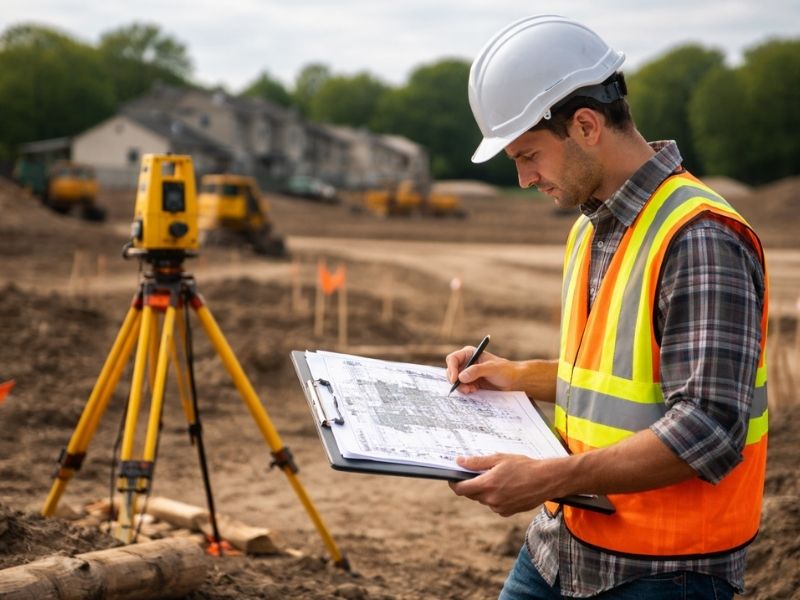
If you’ve ever watched a development project stall because the site data was wrong, you already know how expensive bad information gets. LiDAR mapping is changing that. It gives developers faster, more accurate terrain data before a single dollar goes into grading or design, and it’s quickly becoming the standard for serious land development work.
What Is LiDAR Mapping?
LiDAR stands for Light Detection and Ranging. A sensor fires millions of laser pulses per second at the ground and measures how long each pulse takes to bounce back. The result is a dense “point cloud,” a three-dimensional picture of the terrain with vertical accuracy down to 10 centimeters, according to the U.S. Geological Survey.
That matters because ground conditions are rarely what they look like on paper.
When a drone carries a LiDAR sensor over a site, it captures everything: bare soil, tree canopy, drainage channels, subtle elevation changes that wouldn’t show up on older maps. And it does it fast. A 200-acre site that would take a traditional ground crew 3 to 5 days to survey can be flown in 2 to 3 hours.
Why Developers Are Using LiDAR Mapping on More Projects
Speed is the first reason. But accuracy is the bigger one.
Traditional ground surveys are reliable, but they sample the terrain at specific points. LiDAR captures 200 to 400 data points per square meter across the entire site. That density reveals problems early, before they show up as change orders.
Here’s what developers are using it for:
Grading and earthwork planning. Accurate cut-and-fill calculations depend on accurate elevation data. LiDAR-generated digital elevation models give engineers the numbers they need to optimize earthwork before the job starts.
Drainage and stormwater design. LiDAR picks up subtle grade changes that ground surveys miss. That means stormwater engineers get a clearer picture of how water moves across the site, and how to manage it.
Subdivision planning on large tracts. When you’re laying out roads, lots, and utility corridors across a large parcel, having a complete 3D terrain model reduces the guesswork at every phase.
Sites with heavy vegetation. LiDAR pulses penetrate tree canopy to record the actual ground surface underneath. That’s critical on wooded parcels where photogrammetry alone won’t show you what’s there.
LiDAR Mapping vs. Traditional Surveying: What’s the Difference?
Both methods produce accurate data. The difference is scope and speed.
Traditional surveying is still the right tool for legal boundary work. Property lines, corners, and plat maps require a licensed surveyor using methods that hold up in court. LiDAR doesn’t replace that.
What LiDAR replaces is the time-consuming task of capturing detailed topographic data across large areas. According to the USGS, LiDAR surveys can cut mapping timelines by up to 60 percent compared to traditional ground-based methods. Some sources put field data collection savings as high as 80 to 90 percent on large sites.
For developers, the practical result is this: you get better terrain data, faster, at a cost that makes sense on projects of scale.
When LiDAR Makes the Most Sense
LiDAR isn’t the right call on every project. A small residential lot doesn’t need it. But it earns its cost quickly when:
- The site is 10 acres or larger
- The terrain is uneven or heavily wooded
- The project involves road design, stormwater engineering, or utility routing
- You need a 3D model for engineering or architecture coordination
- The site has drainage concerns that need to be solved before design begins
How the Data Gets Used After the Survey
The raw point cloud is only the starting point. Once it’s processed, surveyors and engineers can generate:
Digital elevation models (DEMs). A gridded surface that shows ground elevation across the entire site. Used for grading design, flood analysis, and drainage planning.
Contour maps. Derived directly from the DEM, these give architects and site engineers the topographic context they need to design.
3D site models. Useful for project visualization, stakeholder presentations, and coordination with design teams.
Bare-earth models. Vegetation and structures are stripped out, leaving only the ground surface. Useful for sites where tree cover hides the real grade.
All of this data can be imported into CAD and GIS platforms, which means it plugs directly into the tools your engineers already use.
What the LiDAR Market Looks Like Right Now
The numbers show how fast adoption is moving. The LiDAR market was valued at about $2.06 billion in 2024 and is projected to reach $15.37 billion by 2033, growing at roughly 25 percent per year. That growth is being driven by construction, infrastructure development, and land planning, not just tech or autonomous vehicles.
More developers are requesting LiDAR data as part of the pre-design phase because the cost of getting it is dropping while the cost of not having it stays the same.
Frequently Asked Questions
Can LiDAR mapping replace a traditional boundary survey?
No. LiDAR is a topographic data collection tool. It captures terrain and elevation data, not legal property boundaries. You still need a licensed land surveyor for boundary work, plat preparation, and anything that affects legal ownership.
How accurate is drone LiDAR for land development work?
Drone LiDAR typically achieves vertical accuracy of around 10 centimeters, which meets the requirements for grading design, drainage engineering, and site planning on most development projects.
How long does a LiDAR survey take?
A 200-acre site can be flown in roughly 2 to 3 hours. Processing the point cloud data into usable deliverables takes additional time depending on the complexity of the site and the outputs needed.
Is LiDAR worth the cost on smaller projects?
For sites under 10 acres with simple terrain, traditional topographic methods are usually more cost-effective. LiDAR delivers the best return on larger or more complex parcels where the data density and speed justify the cost.
What file formats does LiDAR data come in?
Processed LiDAR data is commonly delivered as LAS or LAZ point cloud files, along with GeoTIFF elevation rasters and DXF or DWG files for use in CAD. Most civil engineering and GIS software can import these formats directly.
