
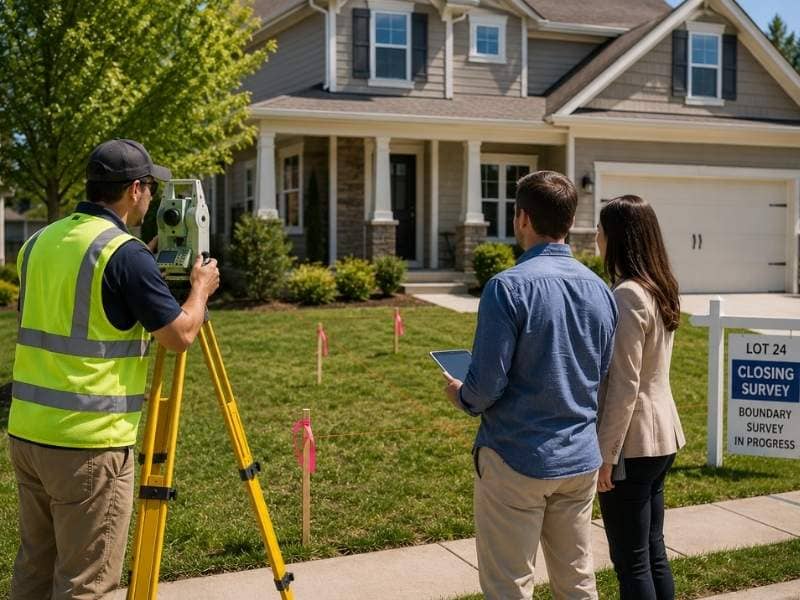
Buying or refinancing property involves several parties working toward the same closing date. A loan closing survey provides current information about the property so buyers, lenders, attorneys and title companies can verify important details before documents are signed. Completing the survey early helps identify issues that could otherwise delay the transaction.
What a Loan Closing Survey Puts on the Table
A loan closing survey is the up-to-date property map that everyone at a closing relies on. It shows the boundaries, the buildings and any features that could affect the deal, all confirmed against the records. With that map in hand, the people closing the deal work from facts instead of assumptions.
The survey earns its place by settling questions that tend to surface late. It confirms the home sits inside its boundaries, shows whether anything crosses a line and flags easements that touch the property. Those answers keep a closing from stalling over a last-minute doubt.
Because it ties the ground to the paperwork, the survey acts as a checkpoint. Everyone can see that the property matches what the contract and loan documents describe. That match is what lets the deal move to signing without second-guessing.
How the Survey Serves Both Sides of the Deal
A loan closing survey protects the buyer and the lender at the same time. The buyer gets proof of exactly what they’re purchasing, down to the true lot lines and any limits on the land. The lender gets confirmation that the property backing the loan is solid and matches the paperwork.
That shared benefit is what makes the survey so useful. Both sides want the deal to close, and both need to trust the property is what it claims to be. One accurate document gives each of them the assurance they need to sign.
When either side lacks that proof, doubt creeps in and slows things down. A buyer might hesitate over an unclear boundary, or a lender might hold back until a question is answered. The survey removes those hesitations before they turn into delays.
Catching Deal-Breakers Before the Closing Date
Some property problems are big enough to stop a closing cold, and a survey brings them out early. An encroachment, a boundary that doesn’t match the deed or an easement no one mentioned can all derail a deal at the last minute. Finding them ahead of time gives everyone room to react.
Early discovery changes what you can do about a problem. With time to spare, the parties can fix the issue, adjust the terms or plan around it before the closing date. Discover the same problem at the table, and the closing often has to wait.
For a buyer especially, this timing matters. A problem caught early is a negotiating point, while the same problem caught late is a crisis. The survey turns a possible ambush into a manageable step.
One Shared Record for Buyer, Lender and Attorney
Closings involve several parties, and they move fastest when everyone reads from the same page. A loan closing survey becomes that single reference, so the buyer, the lender, the attorney and the title company all see identical property details. No one works from an outdated or conflicting version.
That alignment prevents a common cause of delay. When parties rely on different documents, small differences turn into questions, and questions turn into holdups. A shared survey closes those gaps before they start.
Each party uses the same survey in its own way:
- The buyer confirms the property matches what they agreed to buy
- The lender verifies the collateral supports the loan
- The attorney checks the legal description and any exceptions
- The title company clears survey-related items on the policy
With everyone pointing to one trusted document, the closing team spends its time finishing the deal instead of reconciling paperwork.
Crossing the Finish Line With Fewer Delays
A loan closing survey helps a deal reach the finish line on schedule. When everyone has the confirmed property details early, the closing team can complete its steps without stopping to chase information. That steady momentum is what keeps a target date realistic.
Delays usually come from surprises, and the survey removes many of them in advance. The team handles a boundary question, a missing easement or a records mismatch during review instead of at the table. Each problem solved early is one less reason for the closing to slip.
The payoff is real for everyone involved. Buyers keep their plans on track, lenders fund on time and sellers avoid a stalled deal. A little accuracy up front protects the whole timeline.
Frequently Asked Questions
What is a loan closing survey?
It’s a current survey completed as part of a real estate closing to confirm the property for the transaction. It maps the boundaries and improvements and checks them against the records. Buyers, lenders and attorneys use it to close on accurate information.
Why would a lender request a loan closing survey?
A lender wants to be sure the property securing the loan is exactly what the documents describe. The survey confirms the boundaries and shows whether anything crosses a line or sits under an easement. That certainty protects the lender’s stake as the money goes out.
Who uses a loan closing survey?
Several parties do. The buyer relies on it to confirm what they’re buying, the lender to protect its loan, the attorney to check the legal details and the title company to clear survey items. Each one reads the same document for a different reason.
Can a loan closing survey help avoid closing delays?
Yes. Most delays start with a surprise or a disagreement about the property, and the survey settles both early. When every party works from the same confirmed details, there’s little left to hold up the signing.
When should a loan closing survey be completed?
Finish it early in the closing process, well before the scheduled date. That gives the team time to review the results and resolve anything that comes up. A survey ordered too late can push the whole closing back.