
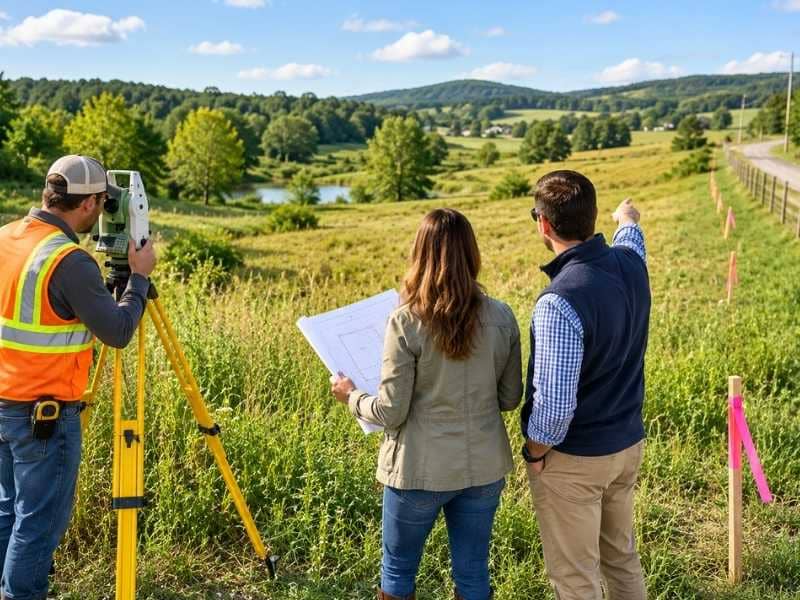
Buying land involves more than reviewing a listing or walking the property. A due diligence survey gives buyers accurate information about boundaries, access and site conditions before closing. By identifying potential issues early, the survey helps buyers make informed decisions and avoid costly surprises after the purchase.
Why a Due Diligence Survey Matters Before You Buy
Buying land is a big commitment, and you want to know what you’re getting before you sign. A due diligence survey gives you that knowledge by showing the real facts about a property, not just what a listing claims. It’s the step that turns a hopeful guess into an informed decision.
Sellers and listings tend to show a property at its best. A listing might round the acreage up, sketch the boundaries loosely and skip the problem spots. A survey checks all of it against the ground, so you learn the truth while you can still act on it.
The timing is what makes this survey so valuable. Order it during your review period, and you have room to renegotiate the price, add conditions or walk away. Skip it, and any surprise you find later becomes your problem to solve.
How a Due Diligence Survey Backs Up Your Plans
Most people buy land with a plan in mind, whether that’s a home, a business or a long-term investment. A due diligence survey tells you whether the property can actually support that plan. It’s far better to learn about a limit now than after you own the land.
Say you picture a house on a quiet acre. The survey shows the buildable area once you account for setbacks, easements and any unbuildable ground. Sometimes a lot that looks big has far less usable space than a buyer expects.
The same goes for bigger projects. If you plan to develop or subdivide, the survey gives you the measured base that engineers and planners need to design anything real. Starting with accurate data keeps your plan grounded from day one.
Look at Access and the Land’s Real Features
Access is one of the first things a buyer should confirm, since land you can’t legally reach is hard to use. A due diligence survey shows where the property connects to a road and whether that access is recorded and clear. A parcel with no legal way loses much of its value.
The survey also brings the site’s physical details into view:
- Slopes and low areas that affect where you can build
- Wet ground or drainage paths that limit usable space
- Existing easements or lines that cross the land
- The true distance and route to road access
Any one of these can change how you use the property, or whether you want it at all. A spot that looks perfect at first glance might sit on ground that floods or costs a fortune to prepare. Seeing these facts early keeps you from paying for problems you didn’t know about.
Match Your Goals to the Real Property
A due diligence survey lets you hold your plan up against reality. Once you can see the true boundaries, access and features, you can check whether the property fits what you actually want to do. That comparison often reveals a gap that a listing hides.
Maybe you wanted room for a workshop, extra parking or a future addition. The survey shows whether the land really has space for those, given its shape and limits. If it falls short, you learn that before you tie up your money.
This step protects you from a costly mismatch. Buyers who skip it sometimes close on land that can’t hold their plans, then face expensive changes or a resale. Matching goals to facts first saves you from that trap.
Decide With Confidence Before You Close
The whole point of a due diligence survey is a confident decision. When you know the real size, access, features and limits of a property, you can move forward without second-guessing. That certainty is worth far more than the cost of the survey.
Good survey information strengthens your position, too. If you find a problem, you can bring it to the seller and adjust the deal while you still have the option. If everything checks out, you close knowing exactly what you bought.
Either way, you avoid the worst outcome, which is finding out too late. A survey done before closing turns a risky purchase into a clear one. That peace of mind is why so many careful buyers make it part of every land deal.
Frequently Asked Questions
What is a due diligence survey?
It’s a survey a buyer orders before closing to learn the true facts about a property. The work can cover boundaries, access, physical features and any records tied to the land. The goal is a clear, accurate picture that supports a smart buying decision.
When should I get a due diligence survey?
Order it during the review period, after you have a deal in motion but before you close. That timing gives you room to act on whatever the survey finds. Waiting until after closing removes most of your options.
Can a due diligence survey help before buying vacant land?
Yes, and it’s especially valuable there. Vacant land hides its problems well, such as unclear access or ground that can’t support a build. A survey brings those issues to the surface before you commit.
What information does a due diligence survey provide?
It shows the property’s true boundaries, its access to a road and the features that affect use, such as slopes and wet areas. It can also flag easements or records that limit what you can do. Together, these details tell you what you’re really buying.
Is a due diligence survey useful for future development?
Very. If you plan to build or develop, the survey gives your engineers and designers the accurate base they need. Starting a project on solid measurements prevents costly redesigns down the road.