
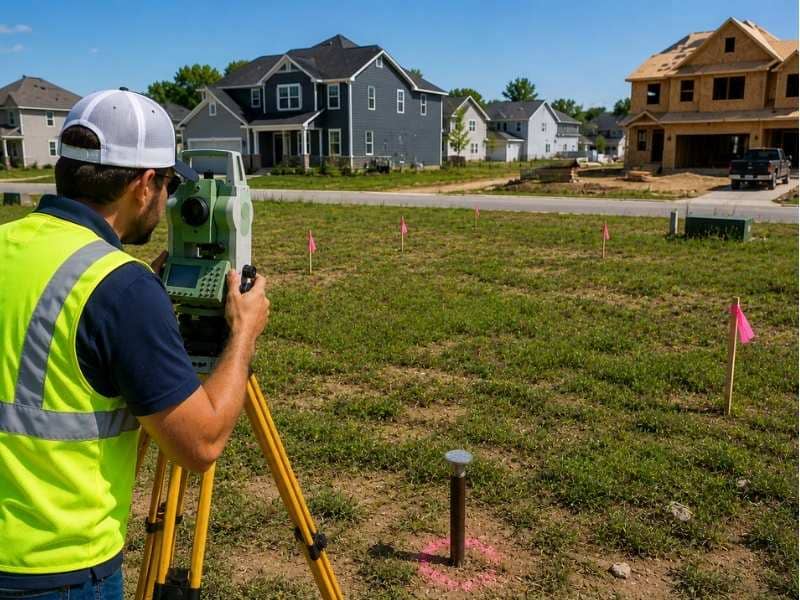
Buying land sounds exciting until you realize you don’t know exactly where it ends. A property survey solves that problem. It’s a legal map of your land’s size, shape, and borders, created by a licensed surveyor so you’re not relying on guesswork. If you’re considering a lot near a new neighborhood or housing development, this step matters even more. Builders move fast, lines get redrawn, and old maps stop matching reality. A property survey gives you the real picture before you make a final decision.
The Legal Map Behind Every Land Purchase
A property survey is a precise map made by a licensed surveyor. It shows a land parcel’s legal boundaries, corners, and overall shape. Surveyors use measured data and public land records, not estimates, so the lines on a survey hold up if a dispute ever happens.
Think of it as a far more accurate version of the property outline you might see online. Those online maps round things off and often miss small details. A real survey doesn’t. It pins down the exact edges using proper equipment and legal records, which removes the guesswork that causes boundary disagreements later.
What You Risk by Skipping This Step
A property survey confirms that the lot size and boundaries match what the seller claims. It also catches problems, such as fences, sheds, or driveways crossing onto the land, before you become the legal owner. Buyers who skip this step often discover encroachments only after closing, when fixing them costs far more time and money.
You can’t protect what you don’t understand. Buying land without a survey is a bit like buying a used car without checking under the hood. It might be fine, but it might also come with a costly surprise.
A survey tells you exactly what you’re paying for. It confirms the acreage and reveals issues early, before they become your legal headache. Common problems include:
- A neighbor’s fence sitting partly on your land
- An old shed or structure built past the boundary line
- A driveway or access road crossing into someone else’s property
Catching these issues before closing gives you leverage. You can negotiate a price adjustment, ask the seller to resolve the problem, or decide to walk away. Catching them after closing means the problem now belongs to you, often along with legal fees.
How New Construction Changes the Ground Rules
Rapid development changes how land gets divided, sold, and recorded. Because of this, older survey data can fall out of date faster than most buyers expect. A current survey accounts for recent subdivisions, new roads, and utility installations that older records may not reflect.
New housing developments tend to appear quickly, and that growth reshapes the ground beneath what used to be stable boundaries. Lots get split, roads get added, and utility lines go in. All of this can shift records that buyers assume are still accurate.
When land near a new development gets resold, the survey on file can be years behind reality. Buyers often assume that because everything around them looks new, the paperwork must be new too. That assumption is wrong more often than people think. A fresh survey closes the gap between what’s officially recorded and what’s actually on the ground.
The Details a Surveyor Will Map Out
A good survey does more than mark four corners and stop there. It maps out everything relevant to ownership and future use. Here’s what it typically reveals:
- Exact property corners and boundary lines
- Encroachments, like a neighbor’s fence or shed crossing onto the lot
- Existing structures, including driveways, sheds, and outbuildings
- Easements, which are sections of land where utility companies or others hold legal access rights
- Roads, walkways, or shared access points near the property
- Natural features like creeks, slopes, or wooded areas that could affect future building plans
This information matters whether you plan to build right away, add a structure later, or simply want certainty about what you own. Without a survey, you’re relying on assumptions, and assumptions rarely hold up in a property dispute.
Picking the Right Moment to Order One
The best time to schedule a property survey is before closing, not after. A pre-closing survey gives you room to act on whatever it finds, while a discovery made after closing usually requires legal action to resolve.
Timing changes everything here. If the results show a smaller lot than advertised, or a structure encroaching on the boundary line, you can ask for a price adjustment, request repairs, or decide the deal isn’t right anymore.
Wait until after closing, and that leverage disappears. At that point, you own the problem, and resolving it usually means hiring an attorney and possibly heading to court. A survey ordered upfront almost always costs less than a dispute settled later.
If you’re buying land near a new development, it helps to build the survey into your timeline early. Ask your real estate agent or attorney about adding a survey contingency to your offer, so the deal depends on accurate results before anything is final.
Frequently Asked Questions
What does a property survey actually involve?
A licensed surveyor measures the land using specialized equipment and cross-references public land records to create a legal map. This map shows the exact boundary lines, corners, and shape of the property, and it can be used as evidence if a dispute ever arises.
Is a property survey really necessary before buying land?
Yes, because it confirms the lot size and boundaries match what’s stated in the listing or contract. It also catches issues like encroaching fences or structures before you become legally responsible for resolving them, which protects you from costly surprises after closing.
What kinds of features show up on a survey report?
A survey report typically includes property corners, boundary lines, existing structures like driveways or sheds, easements where utility companies hold access rights, and any nearby roads or natural features that could affect future building plans.
How much time should I budget for a property survey?
Most surveys are completed within a few days to a couple of weeks. The timeline depends on the size of the lot, how complicated the boundaries are, and how accessible the existing land records happen to be.
Can a buyer request their own survey, or does it have to come from the seller?
Buyers can request their own independent survey, and many choose to during the due diligence period before closing. This gives you control over the process and ensures the results reflect the most current conditions of the land.