
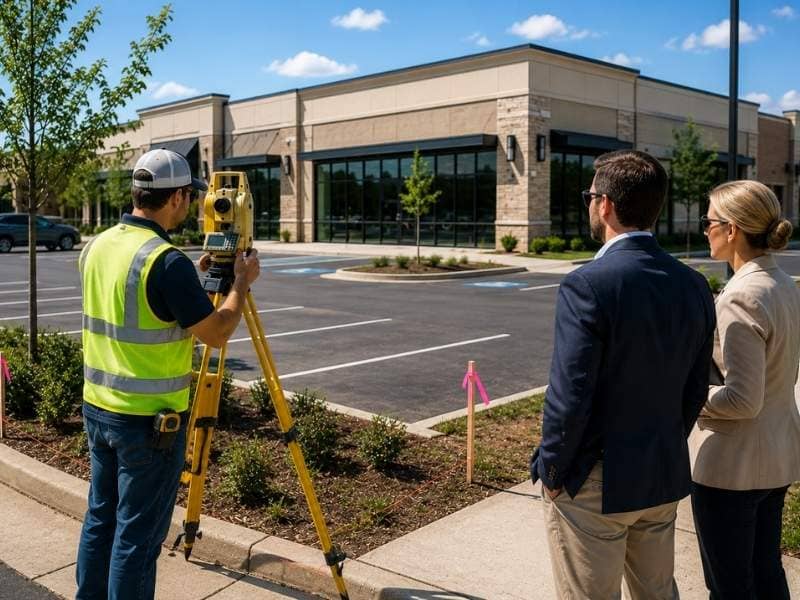
Commercial real estate transactions involve significant financial and legal considerations. An ALTA title survey helps buyers, lenders and attorneys verify that the property’s physical features match the title records before closing. By identifying potential issues early, the survey supports informed decisions and helps keep commercial deals on schedule.
How an ALTA Title Survey Helps Buyers See the Full Picture Before Closing
A commercial property deal involves more than the price and the paperwork. Buyers need to know exactly what they’re getting, and an ALTA title survey is built to answer that.
This type of survey combines boundary information with details tied to the title itself. It shows where the property lines actually fall, what structures sit on the land, and whether anything on the ground conflicts with what the title documents describe. That combination is what sets it apart from a standard survey.
For a buyer, this matters because commercial deals often move fast and involve a lot of money. Skipping this step to save time can mean missing something that changes the value of the deal entirely. An easement running through the middle of a planned expansion. A building that sits partly over a property line. A right of way that limits how the land can be used.
An ALTA title survey brings these issues into view before the deal closes, not after.
What an ALTA Title Survey Shows About the Site Itself
Beyond boundaries, an ALTA title survey documents the physical features that matter for how a property will actually be used. This includes buildings, parking areas, driveways, and points of access to public roads.
For a commercial buyer, these details often carry more weight than people expect. A retail property with limited parking might not support the business plan a buyer has in mind. A warehouse with only one access point could create problems for delivery trucks. A shared driveway between two properties might raise questions about who has the right to use it.
The survey typically documents:
- Building locations and their distance from property lines
- Parking areas and how many spaces are available
- Points of vehicle and pedestrian access
- Utility lines and where they cross the property
- Any encroachments from neighboring structures or features
Having this information laid out clearly lets a buyer compare what’s on the ground with what the deal assumes. If something doesn’t match, it shows up here first.
Why Lenders and Attorneys Rely on Survey Results
Commercial closings usually involve more people than just the buyer and seller. Lenders and attorneys play a direct role, and both groups depend on the ALTA title survey to do their jobs.
Lenders use the survey to confirm that the property matches what’s described in the loan documents. If the survey reveals an encroachment or a boundary conflict, that can affect how a lender views the risk of the loan. Some lenders will not finalize financing until survey issues get resolved.
Attorneys use the same survey to check for conflicts between the title and what actually exists on the property. Easements, rights of way, and boundary lines all get cross-checked against the legal description in the title documents. If something in the survey contradicts the title, that gets flagged and addressed before closing.
Because both groups are reviewing the same document, the survey becomes a shared reference point. Everyone involved in the deal is working from the same set of facts, which reduces the chance of disagreements later.
Comparing Survey Results With Property Records
A survey on its own tells part of the story. Comparing it against existing property records is what reveals whether something needs a closer look.
Property records include the title, prior surveys, recorded easements, and public documents tied to the land. When these are compared side by side with new survey results, gaps become obvious. Maybe an easement was never recorded correctly. Maybe a fence installed years ago doesn’t match the boundary in the deed. Maybe a structure was built without accounting for a utility line running underneath it.
Catching these gaps early gives everyone involved time to sort them out before they turn into bigger problems. Some issues can be resolved with a simple correction to the paperwork. Others require more work, like adjusting an agreement between neighboring property owners. Either way, finding the mismatch before closing is far easier than discovering it after.
Catching Small Problems Before They Delay Closing
Small issues found early rarely cause major disruption. The same issues found late, sometimes days before closing, can stall a deal entirely.
An ALTA title survey gives buyers, lenders, and attorneys a chance to review site conditions well ahead of the closing date. That window matters. If a survey turns up something unexpected, like an encroaching structure or an unrecorded easement, there’s still time to negotiate a fix, adjust the deal terms, or bring in additional documentation.
Waiting until the final stretch of a deal to review survey results removes that flexibility. Problems that could have been resolved calmly with time to spare instead become last-minute scrambles. In some cases, this pushes closing dates back. In others, it can put the entire deal at risk.
Reviewing the survey early is a simple step that protects the timeline everyone is counting on.
Frequently Asked Questions
What is an ALTA title survey?
An ALTA title survey combines boundary measurements with information tied to the property’s title, including easements, encroachments, and site features like buildings and access points.
Why do commercial buyers need an ALTA title survey?
It gives buyers a clear view of what’s actually on the property and whether that matches the title documents, helping them avoid surprises after the deal closes.
Who uses an ALTA title survey during a real estate deal?
Buyers, lenders, and attorneys all review the survey. Lenders use it to confirm loan details, while attorneys use it to check for conflicts between the title and the physical property.
Can an ALTA title survey help prevent closing delays?
Yes. Reviewing survey results early gives everyone time to resolve issues before closing, rather than discovering them at the last minute.
When should an ALTA title survey be ordered?
It should be ordered as early as possible in the transaction, giving buyers, lenders, and attorneys enough time to review the results before the closing date approaches.